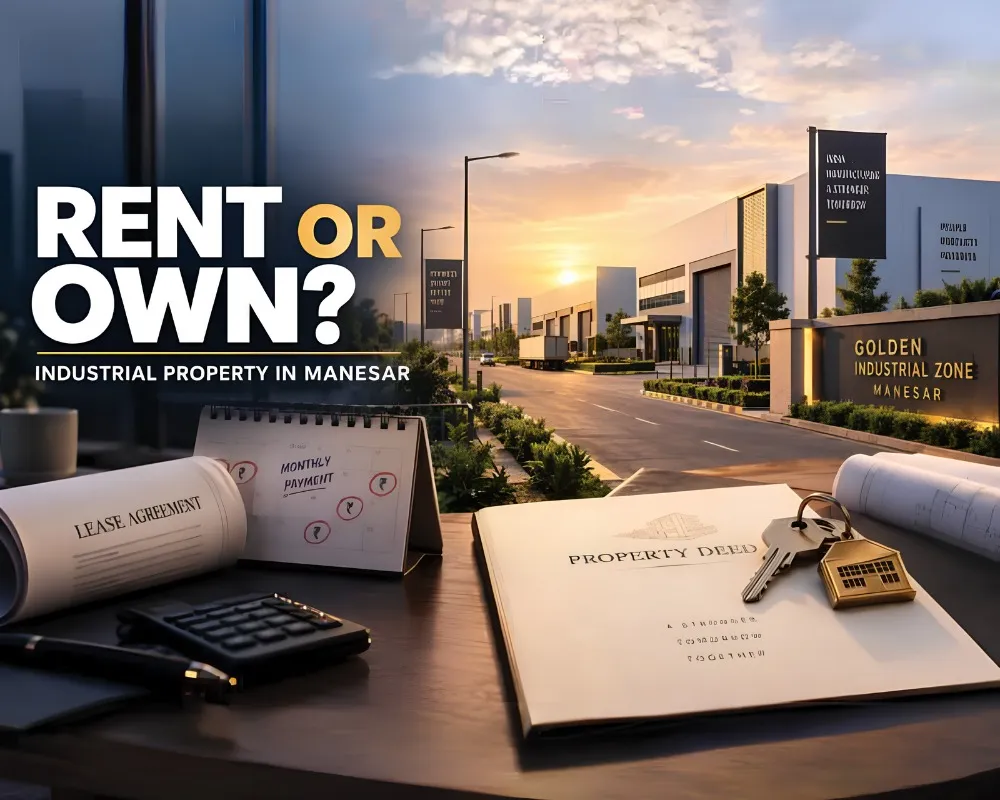
A rented factory can feel perfectly practical when a business is young. The commitment is lower, the move is faster and capital remains available for machinery, people and working stock. The equation changes when the business grows.
A new production line may need structural work the landlord will not allow. Heavy logistics trucks may struggle to turn inside cramped premises. Power capacity may be difficult to increase. Rent rises predictably at every renewal, yet every rupee spent on heavy flooring, custom utilities, advanced ventilation, effluent treatment, or fire infrastructure improves someone else's property.
At that stage, the real question is not whether ownership always beats leasing. It is whether the factory has become too important, too specialised and too permanent to remain dependent on rented space.
Leasing usually works better when demand is uncertain, the required location may change, or the business must protect capital for immediate operations. Buying industrial land becomes far more compelling when the company expects to stay in the same region, needs a purpose-built facility, and wants room to expand without renegotiating its premises every few years.
The right answer depends on cash flow, financing, operating horizon, space requirements and the value the business places on control. A proper comparison should therefore include far more than monthly rent versus a loan instalment.
What Leasing Gives a Growing Factory
Leasing remains a sensible business tool in the right circumstances. It reduces the upfront commitment and can help a company enter a new market quickly. It can also suit a project with a short contract, a temporary warehouse requirement, or a business whose production model is still evolving.
Leasing is typically optimal when:
- Testing new markets: The company is testing a new market, product line, or regional pilot.
- Demand volatility: Demand is volatile and future space requirements are difficult to predict.
- Working capital protection: Working capital is more valuable inside the direct operating business and inventory.
- Standardised setup: The unit needs a standard building with very little structural customisation.
- Short operating horizon: The management team expects the location to change within a limited period.
In these situations, flexibility can be worth more than ownership. The lease should still be reviewed carefully for escalation clauses, lock-in periods, renewal rights, reinstatement obligations, and written permissions to modify the property.
Five Signs the Business May Have Outgrown Renting
When an enterprise transitions from early-stage flexibility to sustained industrial production, rented premises frequently present operational friction. Here are five unmistakable indicators that your business has outgrown tenant status:
Every expansion requires landlord approval
Industrial growth rarely fits neatly inside an unchanged shell. New machinery may need stronger reinforced flooring, higher electrical load sanctions, specialised ventilation, exhaust ducts, additional fire fighting tanks, or wider loading bays. Delays in obtaining landlord consent directly impede production deadlines and client commitments.
The company keeps paying for permanent improvements
Factory fit-outs are rarely portable. Civil structural work, industrial drainage, heavy cabling, bus-ducts, deep machinery foundations, and utility upgrades stay behind when the lease expires. Repeating that capital expenditure at successive premises creates a compounding, non-recoverable expense.
Space is dictating the production plan
A manufacturing plant should be engineered strictly around safe, ergonomic, and streamlined material flow. When raw materials, work-in-progress, finished goods, container loading, and employee circulation fight for the same constrained square footage, the building itself limits production volume.
A forced move would disrupt customers
Relocating an active, calibrated manufacturing plant involves heavy crane shifting, disassembling complex lines, fresh statutory inspections and pollution consents, workforce dislocation, and costly supply chain shutdowns. The operational losses often dwarf visible transportation expenses.
The business is permanently committed to the region
If key automotive OEMs, suppliers, raw material vendors, specialised technicians, and distribution corridors already anchor your business firmly to Greater Gurugram, frequent relocation provides zero strategic value. Long-term site tenure enables confident capital expenditure.
Compare Total Occupancy Cost: Leasing vs Ownership
Monthly rent is only one fragment of the leasing expenditure. Likewise, the purchase price is only one part of property ownership. A rigorous financial model must evaluate the total occupancy cost across the company's full operating timeframe.
| Decision Factor | Leasing Property | Land / Facility Ownership |
|---|---|---|
| Initial Commitment | Security deposits, advance rent instalments, and non-recoverable fit-outs | Land equity contribution, financing setup, stamp duty, registration, and architectural fees |
| Recurring Cost | Base rent, periodic escalation (5-10% p.a.), maintenance fees, and common charges | Loan servicing (EMIs build equity), building maintenance, municipal property taxes, and insurance |
| Factory Improvements | Funded by tenant; subject to landlord veto; forfeited upon lease expiry | Custom engineered for owner workflows; adds direct capital valuation to the corporate balance sheet |
| Expansion Capability | Restricted to adjoining tenant vacancies and landlord willingness | Phased vertical or horizontal expansion designed upfront within the owned plot boundaries |
| Exit Scenario | Lease termination notice, potential reinstatement liabilities, loss of site goodwill | Asset can be retained, pledged for credit lines, sold, or leased to generate recurring corporate yield |
| Long-Term Value | Zero terminal value; tenancy rights extinguish immediately upon lease termination | Land and structural improvements appreciate as tangible corporate assets |
A corporate finance team can model these alternatives using the planned holding horizon, projected lease escalations, customised fit-out costs, prevailing borrowing rates, tax depreciation benefits, and estimated residual real estate valuation. Tax treatment and borrowing structures differ significantly, so final decisions should always be evaluated alongside financial, legal, and tax advisors.
Ownership Gives the Factory Room to Work
A purpose-built industrial unit can be engineered directly around actual shop-floor mechanics. When a company owns its plot, every square metre can be allocated deliberately:
- Heavy engineering foundations: Designed for high-tonnage stamping presses, CNC lines, and vibration isolation.
- Utility headroom: Dedicated transformer yards, captive solar integration, DG backup zones, and high-tension load approvals.
- Logistics ergonomics: Multi-bay loading docks, dedicated forklift transit lanes, and ample turning radiuses for 40-foot articulated trucks.
- Workforce amenities & safety: Purpose-built cafeterias, training rooms, R&D laboratories, and compliant fire safety hydrants.
That level of sovereign control improves daily productivity and reduces the repetitive friction of ill-suited premises. Ownership also empowers management to make long-payback capital investments in energy-efficient technologies, solar rooftops, and automated material handling.
Control has a price. Procuring industrial land requires upfront capital, comprehensive title due diligence, statutory clearances, and time for construction. A company should never starve its core operational cash flow merely to own real estate. However, when a firm can responsibly finance development and intends to anchor its manufacturing in the region for a decade or more, acquiring a freehold plot becomes a cornerstone of competitive advantage.
Why Manesar Enters the Buy Versus Lease Decision
Location impacts both leasing and purchasing strategies. When buying industrial land, management must be confident that the surrounding industrial ecosystem will continue to flourish and provide skilled labour, ancillary suppliers, and logistics resilience for decades.
Manesar has evolved into Northern India's premier manufacturing and engineering powerhouse within Greater Gurugram. Anchored by major automobile giants, tier-1 precision engineering, electronics, and consumer durables, ownership here cements vital supply-chain relationships.
Arterial Connectivity from Golden Industrial Zone, Manesar
Industrial movement depends on speed to market. Golden Industrial Zone provides unmatched proximity to national freight arteries:
*Distances and travel times are approximate and should be verified for specific route conditions.
Where Golden Industrial Zone Fits
For manufacturers seeking freehold ownership rather than leasehold constraints, Golden Industrial Zone in Sectors M9, M10, M13, and M14, Manesar offers an exceptional setting.
According to official project details:
- Diverse Plot Configurations: Ranging from 500 square metres to 5 acres, enabling enterprises to acquire exact land parcels tailored to their current plant layouts and future expansion reserves.
- Heavy Vehicle Access: Wide access roads up to 60 metres, guaranteeing smooth entry, turnaround, and dispatch for heavy trailers and multi-axle freight carriers.
- HRERA Certified Project: Part of the wider Haryana RERA registered project The Golden City. The Haryana RERA portal records registration number 100 of 2022, with continuation valid up to 29 September 2027.
- Freehold Clear Title: Complete sovereign control over land tenure, freeing manufacturers from lease renewals, landlord rent hikes, and arbitrary restrictions.
A Five-Question Decision Test for Industrial Owners
Use this practical framework during executive and board-level real estate planning:
Build the Property Decision Around the Business
A growing manufacturer eventually reaches a turning point where physical premises cease to be just an address and become an integral driver of production efficiency, cost control, and enterprise valuation.
Renting preserves short-term liquidity, but it also imposes hard ceilings on engineering customisation, long-term certainty, and wealth creation. Ownership demands disciplined upfront planning, but rewards the enterprise with operational independence and a permanent balance sheet asset.
If your factory is continuously having to adapt itself to the limitations of rented walls, it is time to ask what kind of space your business truly deserves. Golden Industrial Zone provides the freehold land foundation in Manesar for industrial leaders ready to take command of their future.
Frequently Asked Questions
Is it better to buy or lease industrial property in Manesar?
Leasing can suit early-stage businesses seeking short-term operational flexibility or preserving liquidity for rapid working capital cycles. Buying freehold land suits established manufacturers requiring customised machinery foundations, high power loads, operational permanence, and expansion room. The best choice depends on your production horizon, cash flow predictability, and long-term business plan.
What total costs should be compared before buying industrial land?
Compare the initial land equity, loan EMIs, stamp duty, registration charges, statutory permissions, civil construction, utility infrastructure, and maintenance taxes against the full lifecycle cost of leasing—including recurring rent escalations, non-portable fit-outs, reinstatement costs, and relocation risks.
Why do manufacturers prefer freehold industrial plots over leasehold?
Freehold ownership grants complete control over plant layout, structural enhancements, power allocations, and vertical/horizontal expansion without seeking landlord or periodic lease-extension approvals. It also turns real estate expenditures into appreciating corporate balance sheet assets.
Where is Golden Industrial Zone located?
Golden Industrial Zone is strategically located across Sectors M9, M10, M13, and M14, Manesar, Greater Gurugram, Haryana, offering immediate access to a 60-metre-wide arterial corridor connected to NH-48 and the KMP Expressway.
What plot sizes are available at Golden Industrial Zone?
The project offers flexible freehold industrial plot sizes ranging from 500 square metres for precision manufacturing and light industrial units up to 5 acres for large-scale production facilities and logistics hubs, subject to current availability.
Is Golden Industrial Zone part of a RERA registered project?
Yes. The wider project is registered with Haryana RERA under the name The Golden City. The Haryana RERA portal records registration number 100 of 2022, with continuation validity recorded up to 29 September 2027.
Editorial & Regulatory Disclaimer: This article is published for educational and analytical purposes only. Plot buyers and industrial manufacturers should independently verify all statutory approvals, title deeds, permissible zoning and pollution norms, plot availability, and commercial parameters with Worldwide Realty and competent authorities before entering into any purchase commitment.

