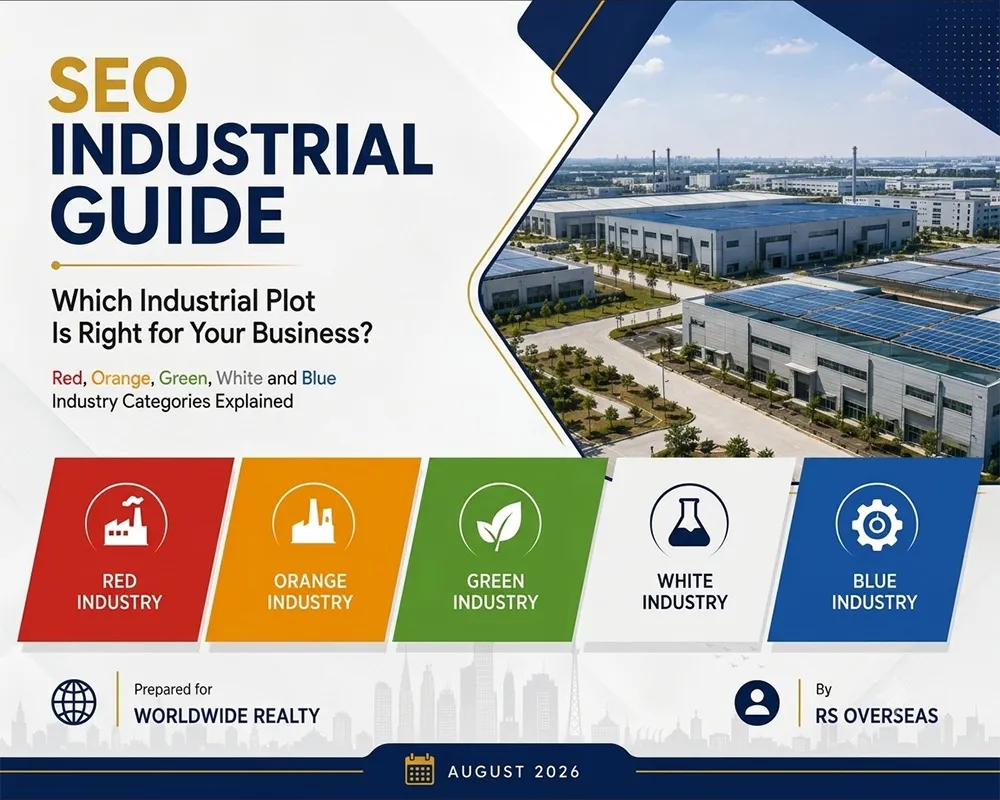
Choosing an industrial plot is not only a question of location, price or connectivity. Before a business purchases land, it must establish whether its proposed activity is permitted at that location and which environmental category applies to its operations.
In India, industrial sectors and projects are classified according to their potential environmental impact. These classifications influence the approvals, pollution-control systems, monitoring and operating conditions that may apply to a unit.
For an entrepreneur considering industrial plots in Manesar, selecting land without understanding this classification can lead to redesign costs, delayed approvals or, in serious cases, an inability to operate the proposed business from the chosen site.
Understanding the category should therefore be one of the first steps in industrial land selection—not a compliance exercise left until after purchase.
The industry-classification system changed in 2025
The Central Pollution Control Board revised and harmonised the classification of industrial sectors in 2025. The Haryana State Pollution Control Board subsequently adopted a consolidated list for Consent Management covering Red, Orange, Green, White and Blue categories from 1 August 2025.
This means businesses should not rely on older online articles that use only the previous four-category system or earlier Pollution Index thresholds. They should check the latest HSPCB classification and any subsequent amendments applicable on the date of application.
The classification is based on pollution potential, considering factors such as air emissions, wastewater, hazardous waste, resource use and the environmental risk associated with the industrial process.
A category describes the potential of a sector or process—not whether an individual unit is currently operating responsibly. Even a well-managed unit must comply with the requirements attached to its notified category.
The five categories at a glance
| Category | General Meaning | Typical Compliance Intensity |
|---|---|---|
| Red | High pollution potential | Highest scrutiny and stronger pollution-control requirements |
| Orange | Moderate pollution potential | Substantial controls and consent conditions |
| Green | Lower pollution potential | Comparatively lighter, but still regulated where applicable |
| White | Practically non-polluting | Simplified or exempted consent treatment as notified |
| Blue | Essential environmental services | Service-specific conditions and monitoring |
1. Red Category: industries with high pollution potential
Red Category sectors have the highest pollution potential under the classification framework. Their operations may involve significant emissions, effluent, hazardous substances, industrial waste or resource consumption.
Depending on the notified sector and production process, examples can include certain chemical manufacturing, metal processing, bulk pharmaceuticals, textile processing, electroplating, cement, distillery or other high-impact activities.
A Red Category unit may require more extensive environmental infrastructure and documentation, including:
- Effluent-treatment or wastewater-management systems
- Air-pollution-control equipment
- Hazardous-waste storage and authorised disposal
- Emission or effluent monitoring
- Emergency-response and safety planning
- Adequate power, water, drainage and access infrastructure
- Periodic reporting and compliance with consent conditions
A business should never assume that every industrial estate can accommodate a Red Category operation. The project’s permissions, applicable zoning, infrastructure capacity and the specific industrial process must all be verified before purchase.
For a Red Category buyer, environmental suitability may be as important as plot size or highway connectivity.
2. Orange Category: industries with moderate pollution potential
Orange Category industries have moderate pollution potential. They may generate emissions, wastewater or waste that requires control, but their overall environmental impact is generally lower than that of Red Category sectors.
Depending on the process, this category can cover certain food-processing, engineering, surface-treatment, automobile-service, printing, fabrication or other moderately polluting activities. The exact classification must be confirmed from the current list because variations in raw material, fuel, capacity or process can change the applicable category.
An Orange Category business should assess:
- Water consumption and wastewater generation
- Type of fuel and boiler or furnace use
- Air-emission sources
- Chemical or solvent usage
- Solid and hazardous waste
- Noise and traffic movement
- Space needed for pollution-control equipment
Choosing a plot only on the basis of the broad industry name can be risky. Two businesses producing similar end products may fall into different categories because their manufacturing processes are different.
3. Green Category: industries with lower pollution potential
Green Category industries have comparatively lower pollution potential, but ‘Green’ does not mean that the business can ignore environmental approvals or operating conditions.
A Green Category activity may still require controls relating to waste, wastewater, emissions, noise, fire safety or worker safety. Requirements depend on the notified activity, production scale and equipment used.
Haryana has introduced compliance reforms for certain Green Category units, including simplified procedures in specified cases. However, buyers should verify the latest HSPCB rules rather than assuming automatic approval.
Green Category operations may be well suited to planned industrial developments, provided the activity is permitted and the plot has the necessary utilities, access and building provisions.
4. White Category: practically non-polluting activities
White Category is intended for sectors considered practically non-polluting. Haryana expanded and updated its White Category treatment following the 2025 reforms aimed at reducing unnecessary compliance for low-risk activities.
Depending on the current notification, some White Category activities may receive simplified consent treatment or exemption from prior Consent to Establish and Consent to Operate under the Water and Air Acts. This does not remove every legal responsibility.
A White Category unit may still need to comply with requirements relating to:
- Building-plan approval
- Fire and life safety
- Factory and labour regulations
- Electricity and utility connections
- Solid-waste and e-waste rules
- Hazardous-waste rules if any such waste is generated
- Local development and operating permissions
Businesses must also ensure that their process genuinely matches the notified White Category description. Adding a fuel-fired operation, chemical treatment, coating, dyeing or another process can alter the classification.
5. Blue Category: essential environmental services
The revised 2025 framework introduced the Blue Category for essential environmental services. These may include specified waste-management, sewage-treatment or pollution-control service activities.
Blue does not simply mean ‘clean industry’. It identifies environmental-service projects that handle waste or pollution as part of their function and therefore require sector-specific controls.
For most conventional manufacturing-plot buyers, Red, Orange, Green or White will remain the more relevant categories. Blue should nevertheless be included in any current explanation of the framework.
Consent to Establish and Consent to Operate
Consent to Establish (CTE)
Where applicable, Consent to Establish is obtained before establishing or constructing the industrial unit. It allows the pollution control authority to assess the proposed process, capacity, emissions, effluent, waste-management plan and pollution-control arrangements before operations begin.
Purchasing land does not itself grant CTE. A project’s industrial approval and a unit’s environmental consent are separate matters.
Consent to Operate (CTO)
Where applicable, Consent to Operate is required before commercial operation begins. It is generally based on the installed process, pollution-control systems and compliance with the conditions applicable to the unit.
Expanding capacity, adding a new product, changing fuel or modifying the manufacturing process can require an amendment, fresh consent or category reassessment.
How industry category affects industrial-plot selection
Permitted activity
The development must allow the proposed industry and its specific process—not merely ‘industrial use’ in general.
Infrastructure
Red and Orange activities may need greater water, drainage, power, waste-management and pollution-control capacity.
Plot planning
Setbacks, circulation, storage, treatment systems, utility areas and future expansion must fit within the plot.
Neighbour compatibility
A higher-impact operation may be unsuitable near sensitive land uses or lower-impact industrial activity.
Approval timeline
The category and process can influence documentation, technical scrutiny, inspections and commissioning time.
Capital budgeting
Pollution-control equipment, monitoring, treatment plants and specialist consultancy can materially affect project cost.
A practical checklist before purchasing an industrial plot
- Write down the complete manufacturing process, not only the final product.
- List raw materials, chemicals, fuels and expected production capacity.
- Estimate water requirement, wastewater, air emissions and waste generation.
- Identify the applicable HSPCB category from the latest notified list.
- Confirm that the project permits that category and the proposed activity.
- Check whether CTE, CTO, environmental clearance or additional authorisations may apply.
- Review power, water, drainage, effluent and waste-management infrastructure.
- Allow space for pollution-control equipment, storage, truck movement and expansion.
- Verify title, licence, approved layout, RERA registration where applicable and development permissions.
- Obtain written advice from qualified legal and environmental professionals before committing funds.
Common mistakes industrial buyers should avoid
Choosing by industry name alone
Classification depends on the process, fuel, raw material, scale and waste profile—not only the product name.
Using an outdated category list
The framework was revised in 2025 and Haryana has issued subsequent updates. Older four-category references may be incomplete.
Assuming ‘all-zone’ means automatic approval
Availability for multiple categories does not replace unit-specific consent, technical assessment or statutory permission.
Treating pollution control as an afterthought
Treatment systems and storage areas need space, capital and operational planning from the beginning.
Relying only on verbal confirmation
Critical claims about permitted use, approvals and infrastructure should be supported by current documents and professional due diligence.
Why multi-category industrial planning matters
An industrial development designed to accommodate different notified categories can serve a broader range of manufacturers. It can also help businesses find plots aligned with their operational requirements rather than forcing every activity into the same infrastructure model.
However, the phrase ‘all categories’ should be understood carefully. It indicates the development’s intended category coverage subject to its approvals; it does not mean that every process is automatically permitted on every plot.
Choosing the right industrial plot in Manesar
Manesar’s manufacturing ecosystem, highway connectivity and access to Gurugram make it relevant to businesses across automotive, engineering, electronics, packaging, consumer products and several other sectors.
But the right location must also be the right regulatory fit.
A lower-priced plot that cannot support the proposed process can become far more expensive than a properly approved and infrastructure-ready alternative. Conversely, a buyer who establishes the category, utilities and approvals before purchase can plan construction and commissioning with greater confidence.
Worldwide Realty’s Golden Industrial Zone offers freehold industrial plots in Manesar across multiple industrial categories, with plot sizes beginning from 512 sq. metres and larger parcels available. Prospective buyers should confirm the exact permitted activity, current approvals, category applicability and infrastructure specifications for their proposed unit before making an investment decision.
Frequently asked questions
Who decides whether an industry is Red, Orange, Green, White or Blue?
The classification follows CPCB and applicable State Pollution Control Board notifications. In Haryana, buyers should refer to the latest HSPCB category list and obtain professional confirmation for their specific process.
Can two businesses making the same product fall into different categories?
Potentially, yes. Differences in raw materials, fuel, production method, chemical treatment, capacity, emissions or waste can affect classification.
Does a White Category unit need no approvals at all?
No. White Category may receive simplified or exempted consent treatment as notified, but building, fire, factory, labour, waste, electricity and local permissions may still apply.
Can a Green Category plot be used for an Orange Category industry?
Not merely because both are industrial uses. The project must permit the proposed category and activity, and the unit must obtain all applicable approvals.
Should the industrial category be checked before buying the plot?
Yes. The category affects location suitability, infrastructure, design, approval timelines and project cost. It should be verified before committing to the land.
Does buying a plot with multi-category availability guarantee CTE or CTO?
No. The unit’s consent application is assessed on its specific activity, process, capacity and pollution-control arrangements.
Sources and regulatory references
- Haryana State Pollution Control Board — Industrial categorisation for Consent Management
- Haryana State Pollution Control Board — Policy Orders
- Central Pollution Control Board — Categorisation of Industrial Sectors
- Haryana Online Consent Management and Monitoring System
- CPCB — Blue Category of Industries
Regulatory note: Industrial categorisation and consent requirements can change. The latest official notifications and unit-specific professional advice should be checked immediately before publication, purchase or application.

