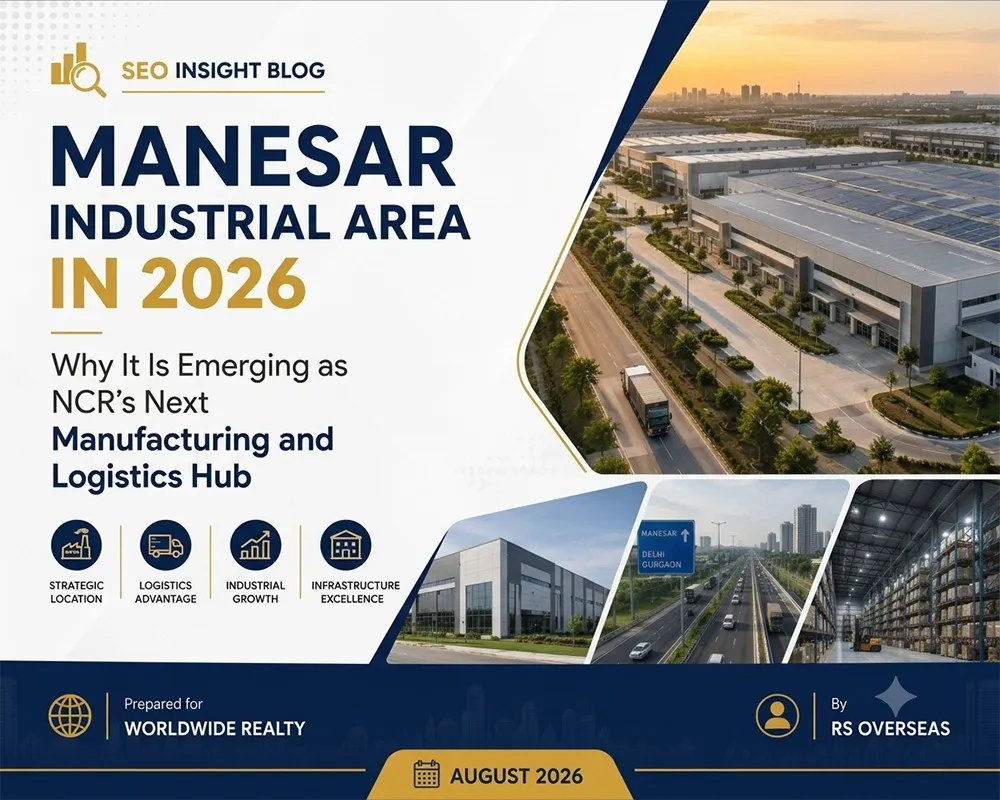
For years, the Manesar Industrial Area has been associated primarily with automobile manufacturing. Today, however, its growth story is becoming much larger.
Improved freight connectivity, expanding global investment, stronger industrial infrastructure and proximity to Gurugram are gradually transforming Manesar into a diversified manufacturing, engineering, research and logistics destination.
For businesses searching for industrial plots in Manesar, this shift is significant. The value of an industrial location is no longer determined only by its distance from a highway. It increasingly depends on access to suppliers, skilled manpower, freight infrastructure, reliable utilities and a supporting urban ecosystem.
Manesar is steadily bringing these advantages together.
From an automobile cluster to a diversified industrial ecosystem
The automobile industry remains central to Manesar’s identity. Major manufacturers and their supplier networks have created an established ecosystem of component makers, engineering companies, logistics operators and specialised service providers.
But the industrial profile of the region is now expanding beyond automobiles.
Businesses operating in sectors such as engineering, electronics, consumer durables, warehousing, packaging, precision manufacturing, technology and industrial services are also exploring the Manesar–Gurugram corridor.
This diversification makes the region more resilient. Instead of relying on one industry, Manesar is developing an interconnected ecosystem in which manufacturers, suppliers, warehouses, research facilities and service businesses can operate close to one another.
1. Rail-linked logistics is changing Manesar’s business potential
One of the most important recent developments is the operational Gati Shakti Multi-Modal Cargo Terminal at the Maruti Suzuki plant in Manesar.
According to the Press Information Bureau, the 46-acre facility is connected to Patli railway station through a dedicated 10-kilometre rail link forming part of the Haryana Orbital Rail Corridor. It has the capacity to handle approximately 4.5 lakh automobiles annually.
Although the terminal currently serves automobile movement, its larger significance lies in what it signals for the region: Manesar is moving towards a more integrated road-and-rail logistics ecosystem.
Efficient freight movement can help businesses:
- Reduce dependence on long-distance road transportation
- Improve access to domestic markets and ports
- Plan inventory and dispatch more efficiently
- Build stronger regional and national supply chains
- Lower logistics-related delays and uncertainty
For manufacturers evaluating industrial land in Manesar, proximity to evolving multimodal infrastructure can become an important long-term advantage.
2. Strategic road connectivity continues to strengthen
Manesar already benefits from its position along NH-48, connecting Delhi, Gurugram, Dharuhera, Rewari and Jaipur. It also has access to the Kundli–Manesar–Palwal Expressway and the wider Delhi-Mumbai economic corridor.
Another important connectivity project is the upgrade of the 5.3-kilometre master road linking the Dwarka Expressway corridor with IMT Manesar.
The ₹49.4-crore project covers the road running through sectors 84–91 and includes service roads, drainage, footpaths, streetlights and road-safety infrastructure. The stretch also connects with NH-48, Sohna Highway and the Southern Peripheral Road.
For an industrial business, connectivity affects much more than travel time. It influences:
- Movement of raw materials and commercial vehicles
- Employee commuting and supplier turnaround time
- Delivery schedules and reach across Delhi-NCR
This is why highway and arterial-road access remains one of the most important considerations when choosing an industrial plot in Manesar.
3. Global investment is bringing research and innovation to Manesar
A major indication of Manesar’s changing industrial profile is the proposed investment by Daikin Industries.
In 2026, Daikin announced the establishment of an India-based R&D subsidiary and a new research and development centre in Haryana. The centre is intended to support product development for markets across Asia, Oceania and Africa, particularly for large-scale HVAC applications used in factories, commercial facilities and data centres.
The project has been reported as an investment of approximately ₹1,000 crore in Manesar, with the potential to create more than 500 employment opportunities.
This development is important because it represents more than another industrial facility. It indicates a gradual movement towards:
- Research-led industrial development and high-value engineering
- Product and software development
- Demand for specialised technical talent
- International investment and collaboration
4. Power infrastructure is being upgraded for industrial demand
Reliable electricity is one of the most critical requirements for manufacturing operations.
A new 66/11 kV GIS substation has been approved for the Technology Park at IMT Manesar at an estimated cost of ₹28 crore. Capacity at the existing Sector 8 substation has also been upgraded, while additional capacity has been added at the 220 kV Transport Hub substation.
These upgrades are intended to address rising industrial loads and improve power reliability. While businesses must still assess the power allocation and backup arrangements available at an individual property, continued investment in the broader grid strengthens Manesar’s ability to support energy-intensive industrial activity.
5. Industrial-area maintenance has received clearer responsibility
Industrial competitiveness also depends on everyday infrastructure: roads, water supply, drainage, street lighting, sewerage and waste management.
In late 2025, HSIIDC took responsibility for maintaining public amenities across Sectors 1–8 of IMT Manesar under an agreement with the Municipal Corporation of Manesar. The arrangement covers roads, water, sewerage, streetlights and green belts.
Clearer institutional responsibility can help improve accountability for industrial-area maintenance—an important consideration for both existing operators and new businesses entering the region.
6. Manufacturing growth is creating demand beyond factory space
Industrial development does not operate in isolation. It generates demand for housing, warehousing, retail, healthcare, transport and commercial services.
Recent reporting indicates that manufacturing activity around Manesar is influencing residential demand, particularly among engineers, plant managers, technical specialists and professionals who prefer to live closer to their workplaces.
This is encouraging a more integrated ‘work-near-home’ ecosystem around the industrial corridor. For businesses, the development of nearby residential and social infrastructure can support:
- Employee recruitment, retention and shorter workforce commutes
- Better access to healthcare and daily amenities
- Accommodation for visiting professionals
Manesar is therefore evolving from a standalone industrial estate into a broader economic district.
What should businesses check before buying industrial land in Manesar?
Land-use approval
Confirm that the land is approved for the intended industrial activity. Manufacturing, warehousing and processing uses may require different approvals.
Pollution category
Determine whether the proposed operation falls under the White, Green, Orange or Red category and whether that activity is permitted at the selected location.
Road and truck access
Check the approach road, internal road width, turning radius and suitability for commercial-vehicle movement.
Power requirement
Evaluate the sanctioned power provision, future load availability, backup arrangements and connection costs.
Water and waste
Confirm water availability, drainage, sewerage, effluent-treatment requirements and waste-disposal provisions.
Expansion potential
Consider whether the plot can accommodate future production, storage, employee facilities and vehicle movement.
Why Manesar Industrial Area deserves attention in 2026
Manesar’s advantage is no longer based on a single project or connectivity promise. Its strength comes from the convergence of several developments:
- An established manufacturing and supplier base
- Access to NH-48 and KMP Expressway
- Improving connection with the Dwarka Expressway corridor
- Rail-linked automobile freight infrastructure
- New power-capacity investments
- Interest from international research and manufacturing companies
Together, these factors are positioning Manesar as a location where manufacturing, logistics, research and urban development can grow alongside one another.
The next chapter of industrial growth
Manesar is not starting from scratch. It already has the industrial base, workforce and supplier network that new industrial destinations often take years to develop.
What is changing in 2026 is the scale and diversity of the opportunity. As freight infrastructure improves and research-led global investments enter the region, Manesar is progressing from a traditional manufacturing cluster towards a more future-ready industrial corridor.
For manufacturers, logistics companies and long-term investors exploring industrial plots in Manesar, the real opportunity lies in selecting legally compliant, well-connected and infrastructure-ready land that can support both present operations and future expansion.
Worldwide Realty’s Golden Industrial Zone offers ready-to-move, freehold industrial plots in Manesar for different categories of industrial activity. Plot options begin from 512 sq. metres, with larger land parcels available depending on operational requirements.
Frequently asked questions
Is Manesar suitable for setting up a manufacturing unit?
Manesar has an established manufacturing and ancillary ecosystem, along with access to NH-48, KMP Expressway and expanding freight infrastructure. Suitability ultimately depends on the proposed industry, pollution category, utility requirement and plot approvals.
What industries can operate in Manesar?
The region supports a range of automotive, engineering, electronics, packaging, consumer-durable, warehousing and other industrial activities. Permitted use varies by the zoning and pollution category of the specific project.
What should I verify before purchasing an industrial plot?
Buyers should verify title, land use, licence, approved layout, permitted industrial activity, road access, power and water provisions, environmental requirements and applicable development charges.
Is it better to buy or lease industrial property in Manesar?
Buying can suit businesses seeking long-term operational control and capital ownership. Leasing may be preferable for companies seeking flexibility or lower initial capital commitment. The choice should be based on business duration, expansion plans and available capital.
Is Manesar connected to major logistics routes?
Yes. Manesar has access to NH-48 and the KMP Expressway, while road links towards the Dwarka Expressway corridor are being strengthened. A dedicated rail-linked automobile cargo terminal is also operational at the Maruti Suzuki facility.
Sources and further reading
- Press Information Bureau — Gati Shakti Multi-Modal Cargo Terminals
- Daikin Industries — India-based R&D subsidiary announcement
- Hindustan Times — Daikin investment in Manesar
- The Economic Times — Dwarka Expressway to Manesar road connection
- The Times of India — Manesar power-grid upgrade
- HSIIDC maintenance of IMT Manesar amenities
Disclaimer: This article is for informational purposes only. The latest official notifications and unit-specific professional advice should be checked immediately before publication, purchase or application.

